
Karin Vaneker, a writer and activist in the Netherlands, has been helping me by tackling subjects that haven’t yet attracted much scholarly research for the second edition of the Encyclopedia of Sustainability. She’s written, for example, on including composting and community gardens – important, relevant, and yet somehow a little too close to home for most academics.
 When she told me about a project to help people identify trees in distress, I was intrigued. It seemed like such an easy way to learn to observe our surroundings and find out more about the ecosystems we live in.
After all, trees are almost everywhere. Even in parts of cities that are mostly barren of trees (something that also needs attention), there are often “weed trees” growing, like the famous ailicunthus that gave the title to the bestselling A Tree Grows in Brooklyn.
Karin and an artist friend Anika Franke wrote and illustrated a beautiful leaflet that you can download in Dutch: Bomenkerkhor_boek_Print_binnenwerk. And Karin has made a partial translation into English, which you’ll find below.
We’re planning gradually to translate and adapt the text to be used elsewhere in the world. Karin even began studying trees in Massachusetts and mentioned that she’d read about Seekonk Tree Farm in Great Barrington. I told her that that’s where we get our Christmas tree every year.


Background [Verantwoording]
On May 13, 2000, a massive explosion in the Netherlands made world news. Apart from 23 deaths and about 950 injuries, a fireworks explosion in the city of Enschede destroyed an entire neighborhood. Rebuilding the residential area of about 100 acres, in 2008, was completed with planting an avenue of over 100 princess trees and a visit by the Dutch Queen Beatrix. Six years after the royal visit, in 2016, the curtain fell for the Paulownia trees of about 1000 euros each. In 2016, Roombeek’s Museumlaan became an avenue of sweetgum trees. At present, dieback and decline[1] of young trees isn’t restricted to prestigious locations like Roombeek, all over the city of Enschede young and old trees are succumbing to poor municipal management and climate change. To raise awareness, from early April to 19 August 2021, Anika Franke and Karin Vaneker worked on this tree guide.
Everybody knows what a tree is, but do you recognize a tree in distress? Hopefully this guide is of help.
What is a city tree? [Wat is een stadsboom?]
From cradle to grave, the life of a city tree is not a bed of roses[2]. Increasingly, urban trees are selected for their strength and toughness[3], and their ability to live in or near sidewalks and on small patches of land. In cities fertile soil is scarce and is replaced by barren construction sand. While holding up between sewage pipes and underground cables, the roots may not disturb the pavement or foundation of buildings. Above ground, the trunk and canopy has to be able to withstand exhaust fumes and air pollution, in addition to road salt, dog urine, cigarette butts, vandalism and lawn mowers. And if the city’s pavement is being maintained or renewed, or its branches get in the way of power lines and trucks, a city tree must also be able to survive a significant amputation to its roots and branches.
Increasingly, trees along streets, in yards, and in parks, have to withstand extreme weather conditions. Heat waves and droughts, unexpected freezes and frosts, impose an extra burden on trees. If the stress and struggle for survival weakens a city tree, it becomes vulnerable to pests and diseases.
How to recognize a tree in distress? [Zo herken je een boom in nood]
The decline of trees progresses from soft to hard. Creating new shoots and leaves on the trunk is the last survival attempt.
- Leaves and fruits (wilt and loss).
- See-through trees (bare crowns and dead branches).
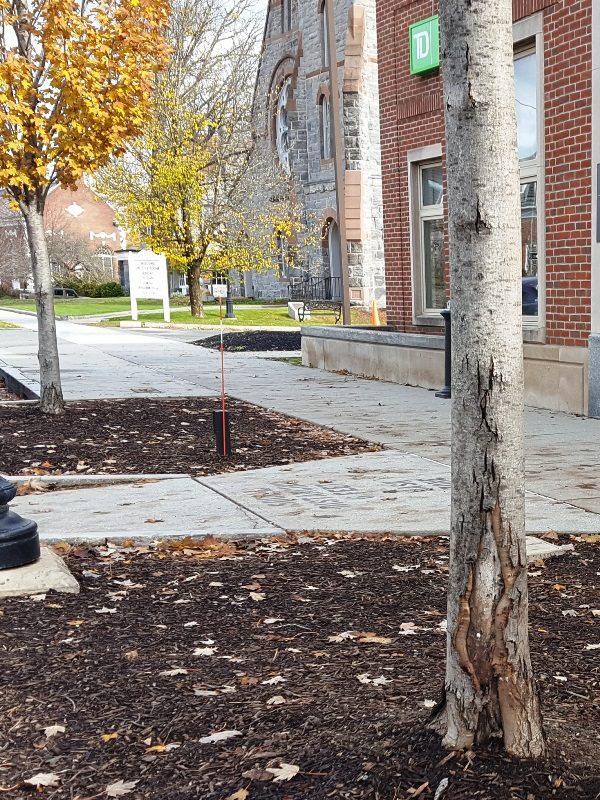
- Cracks and tears in the trunk (bark splitting[4])
- Sunburn (charcoal ‘stains’ on trunk, known as sun scald or southwest injury[5]).
- Diseases and pests[6]
- Wood rot (fungi and mushrooms).
- Bare and barkless (tree trunks and branches)
- Shoots and leaves on the trunk (known as suckers or (water) sprouts[7]).
- Museumlaan Liquidambar styraciflua ‘Worplesdon’ The sweetgum tree grows well in the cold and wet climate of Northwestern Europe.
- Museumlaan Carpinus betulus ‘Fastigiata’ More than 200 species of fungi can occur on the European Hornbeam, which can cause diseases or wood rot.
- Bamshoevelaan Acer platanoides ‘Cleveland’ The Norway maple: the ideal city tree.
- Bamshoevelaan Gleditsia triacanthos ‘Skyline’ The honey locust tree comes from North-America where it grows well on wet, swampy soil.
How to recognize a tree in distress? [Zo herken je een boom in nood][8]
Trees rarely die of ageing, but perish from other factors such as drought, heat, and pollution (abiotic, nonliving factors), and from natural (biotic) factors such as diseases, insects and fungi. The decline of trees progresses from soft to hard. In growing season trees behave differently, for instance by wilting their leaves, and dropping leaves or unripe fruits. In the growing season trees behave differently, by wilting or dropping leaves and unripe fruits in spring and summer. In the next stage, dead twigs, branches and bare crowns become more visible. The bark protects the trunk from drying out, and against diseases and attacks by insects (pests). Cracks and tears in the bark weaken the cambium. The thin layer of cells between the bark and stem transports water and nutrients from the roots throughout the tree, and is crucial to the survival and health of trees. Heat and drought affect the inside and outside of a tree. While the inside is thirsty and hungry, overexposure to sunshine causes sunscald or southwest injury. Cracks, tears, bare tree trunks with charcoal stains all advancing the dieback and decline of a tree. While bacteria and insects take advantage of the tree’s vulnerability, fungi are destroying and causing wood rot. In a last attempt to protect itself and survive, the tree grows shoots and leaves on its trunk.
The survival strategy of trees is based on more than 250 million years of experience and mutual cooperation. Collaboration with city dwellers is difficult, in a city, a tree usually stands alone.
[Remark] underground aspects/symptoms are very important, but ‘soil compaction’ and leaning trees (root system likely death) are not included.
[1] Dieback and decline. Bartlett Tree Research Laboratories. Technical report: https://www.bartlett.com/resources/dieback-and-decline.pdf
[2] Interesting article (2012) about Bloomberg’s MillionTreeNYC. As City Plants Trees, Benefits—and Some Burdens—Grow. “There has always been more need for tree care than need for funds to plant them,”: https://citylimits.org/2012/01/31/as-city-plants-trees-benefitsand-some-burdensgrow/
[3] This phenomenon also occurred during the Industrial Revolution and its simultaneous expansion of factories and cities. Due to it’s hardy characteristics and ability to withstand the 19th century air pollution, cities like London and Enschede planted plane trees.
[4] [Bark splitting] Newly-planted trees; young trees; thin-barked trees are more sensitive.
Fluctuation in growth conditions e.g. dry weather (slow growth) followed by wet or ideal growth conditions (catch up on growth delay). http://plantclinic.cornell.edu/factsheets/barksplitting.pdf
[5] Sunscald is a symptom of bark splitting http://plantclinic.cornell.edu/factsheets/barksplitting.pdf
[6] Symptoms include bleeding (dark stains on trunk and branches). Bumps, discoloration, holes in leaves. Trees covered with insects (‘spider’ nests).
[7] Shoots are an attempt to recover/heal from stressful events such as drought, amputation and severe pruning. The shoots emerge from dormant sprouts on trunks and branches.
[8] “The process of urban tree mortality is complex and differs from trees in non-urban areas (Roman et al. 2016). Trees located in heavily built-up and landscaped urban areas—such as boulevards/parkways and lawns—experience very different growing conditions compared to trees growing in natural forests. For example, urban growing conditions can be more stressful due to factors like limited rooting area, degraded soils, and excessive heat, or they can be enhanced through practices like irrigation and fertilization (Urban 2008; Miller et al. 2015).” Urban Tree Mortality: What the Literature Shows Us (2019). https://www.fs.fed.us/nrs/pubs/jrnl/2019/nrs_2019_hilbert_003.pdf


Leave A Comment