

 Since I began working on the Encyclopedia of Chinese Cuisines, questions about wine pairing constantly come up. Can you, or should you, drink wine with Chinese food? Which wine should you drink? Which wine should you serve Chinese guests?
When I use the word wine, I mean wines made in the European tradition from grapes, not rice wines or any grain beverage, for which I use the Chinese word jiu. Chinese hard liquor is called baijiu, or white jiu, and because it is consumed with meals in China, we’ll eventually do some tasting with it, too. Even though I agree with a friend who described it as smelling like gasoline, and cannot imagine tasting rose-scented baijiu I’ve read about.
As I’ve talked to Chinese colleagues about wine, prepared meals for Chinese friends, and eaten with mixed groups in the United States and in China, I have become convinced that most of what’s written about pairing Chinese food with wine is wrong.
I was eating dim sum with friends in New York the other day. One of them, a young Chinese American, asked if I could recommend a book on pairing wine with Chinese dishes. She’d been stumped when arranging a Chinese dinner for her and her boyfriend’s parents. “If we’d been eating Western food, we could have picked nice wines for each course, but we couldn’t figure out what really worked with Chinese food and it was really annoying.” She’d been talking to a friend in investment banking, another sophisticated Chinese American and said he had the same problem, “He’s used to ordering expensive bottles of wine when he’s the host, but for Chinese food, and Chinese guests, he can’t figure out what to choose.”
We talked about the way all the Chinese people we know only want to drink red wine, while almost all Western food writers say that the wine to drink with Chinese food is white, fruity or sweet wines. “I went to a friend’s wedding shower,” said my friend. “She’d carefully chosen a good red and a good white. But no one drank the white – the whole case sat unopened.”
Is it a European prejudice that fermented grape juice intrinsically works with European flavors and not with Asian ones? Do Western people assume that Chinese food goes with white wine because it looks like traditional Chinese rice wine? Do the Chinese favor red wine because the red is the color of good fortune?
There isn’t a great deal written on this subject. The only piece that came to mind was written by Gerald Asher, the wine editor of Gourmet magazine, and appeared in the back of the late Barbara Tropp’s The Modern Art of Chinese Cooking. Gerald Asher has given me permission to reprint it. I sincerely thank him, and hope that his astute comments will encourage others to delve into this fascinating subject.
WINE – by Gerald Asher
In the West we sometimes drink to accompany food and sometime just for conviviality. “The Chinese,” explains Lin Yutang, a twentieth-century writers, “have not developed the nicety of serving different drinks with different courses of food.” They drink for fun. Wine is nothing but an excuse for a good time, he tells us without apology, for jokes and jokes and noisy games punctuated every so often by a dish. He admits, too, that in China choice of wine is limited, and almost none of it Would fit our own definition: a beverage made from the fermented juice of freshly gathered grapes.
The rice wine of Shaohsing is invested with as much myth and romance as we have generated over the centuries in our tales of Falernian, Hermitage, Vintage Port, and old Bordeaux—the unique quality of Jian Lake water in which the rice is first steeped and steamed before fermentation, the antiquity of the yeast, continually present for more than two thousand years, the wine’s alleged restorative properties and its more evident capacity to inspire the poets and scholars for which Shaohsing is equally distinguished.
But myth and romance do not adequately substitute for the enormous range of subtle variation possible in wines made from grapes. Had such wines been available to them, the Chinese, who allowed few civilized pleasures to slip past them, would doubtless have mastered the art of matching them to their food centuries ago. We are in the fortunate position of having both Chinese food and Western wines, and lack of traditional associations between them should present creative opportunities rather than obstacles.
Isn’t it odd, though, how often those opportunities are wasted Those who should know better tell us that “Chinese food” needs tea, beer, or white wine, miserably dull and condescendingly omnibus advice that nobody would think of giving in connection with “French food,” “Italian food,” or, indeed, any other European food. One respected gastronomic guidebook says dismissingly, and without further explanation, “Chinese food needs spicy white wine.” Yet even if we ignore regional variations and specialties, Chinese food is at least as delicate, as diverse, and as imaginatively constructed as any other, and therefore deserves at least as much care and sensibility in matching to wine. A con census of opinion on wine and food partnerships that work well together has to be based on harmonies, contrasts, and affinities that apply equally to wine and any food. True, Chinese food is designed to sparkle on the palate in a way that could tease attention from an accompanying great Bordeaux, but most French food is designed to do the same. Shallots, garlic, tarragon, and reductions of all kinds are not the ingredients of bland fare. That is why we prefer a simple filet de boeuf or plain lamb chops with such a wine.
Chinese cooking, to a greater extent than Western, is based on harmony, contrast, and affinity within the dish itself, however, and an accompanying wine must conform to that balance or provide, in taste terms, a silken backdrop for it. We tend to match wine to the principal ingredient, be it fish, lamb, chicken, or whatever, and then take its presence into consideration when planning sauce or garnish. A Chinese dish, on the other hand, constructed, like a good perfume, with evanescent top note, sustaining bottom note, and middle substance, must be thought of as a whole, or the wine becomes an intrusion.
I once made the mistake of assuming that an aromatic wine was needed for a chicken dish tangy with lemon and musky with green coriander. But they were just two notes in a chord that contained many others, and the grapey quality of the Rhine wine I chose could not have been more irrelevant, more out of place. The dish needed a wine solid enough not to be overwhelmed by its piquancy, but restrained enough not to pose. A good Chablis, or a young Meursault, perhaps, would have been a far better choice. I had a similar experience with marinated and stir-fried hoisin lamb. A fruity young Beaujolais that I had imagined would go well with its spicy-sweet seemed to be frivolously out of place. A Beune, fortunately to hand, made a more dignified and a more compatible partner.
It is steamed dishes, in my experience, that allow the greatest latitude, however. A young Saar wine with a crisp Riesling bouquet and flavor that would have added an unnecessary and unwelcome baroque flourish to most dishes was excellent with steamed chicken; a richly flavored 1979 Saint-Veran added dimension to steamed crab; and, un believable though it might seem, I have rarely enjoyed a bottle of my limited stock of 1959 Château Lynch-Bages as much as when it accompanied Hunan-style steamed salmon with ginger threads and black beans (page 252(. But then ginger and garlic, I have discovered, add scale to a dish, and make possible, even obligatory, a wine of more pronounced character than might otherwise be the case. When allied to beef or lamb they require the support of a robust red: Burgundy from a year like 1972 or l979 Hermitage or Saint-Joseph from the northern Rhône; California Petite Sirah; or perhaps vigorous Brunello di Montalcino. With chicken or fish they make full-bodied, flavory white or light, fruity red equally acceptable. The breadth that ginger will add to fish, in particular, provides an answer to those California Chardonnays of such intense fruitiness that they distort or overwhelm most other foods.
If you are serving more than one wine with a Chinese meal, the usual caution is needed with sequence. The first wine should not steal the thunder of the second: a light wine should precede a full-bodied one, young before old (unless the latter is fading and might then seem to be thin), and dry before any wine that might have residual sugar. But though we normally prepare the palate for one wine by serving another, unfamiliar combinations with Chinese food are certain to reveal surprising nuances in wines thought to be old acquaintances. Helen Kan of San Francisco once remarked that Western wines brought out flavors new to her in dishes she had eaten all her life. The reverse is also true, and who knows what further hidden charm a favorite simple rosé might disclose when matched to a lettuce-wrapped spicy chicken on page 145. —GERALD ASHER
Do Chinese people really like wine?
I agree with my young Chinese-American friend that Westerners are never going to fully embrace China’s great culinary offerings unless they can consume it with their preferred beverages. But besides that, China is the world’s second-largest consumer, or purchaser, of wine. It breaks my heart to think of all that wine being bought and not enjoyed, merely seen as a status symbol, or quaffed for its health benefits.
At a dinner in New York, I was seated with two Chinese economists whose English was limited. We were served wine, so I began my usual questioning. Do you drink wine often? They nodded. What sort of wine do you drink? They pointed at the glasses. You prefer the taste of red wine? “Red is better for the health,” they said. “And it’s a lucky color.” And do you like wine? They smiled awkwardly and finally shook their heads. “Not really,” they explained. “But, Chinese people drink too much baijiu.”
Admittedly, there are some who don’t believe in pairing wine with Chinese food at all. Why not stick to what the Chinese themselves typically drink: tea, rice wine, liquor made from grains, or just plain hot water? But the Chinese themselves are buying wine and I’d like to see them enjoy it more. I think of Chinese cuisines as an ideal window into Chinese history and culture, so this project is a way to encourage Westerners to try a greater variety of Chinese dishes.
It also needs to be said that many Asian people have a different physical reaction to alcohol than Caucasians—meaning the “Asian flush” or “Asian glow.” But is there a gender difference? That seems unlikely. Yet, I have never met a native-born Chinese woman who drinks wine. (I know there are some, and some Korean wine experts who are women, but drinking remains a male privilege, or downfall, it seems.)
The Chinese themselves, in China and outside it, are in early days of learning about wine, and we outside China have only just begun to have access to something of the range of Chinese dishes and regional cuisines. Our objective, therefore, is to get a better idea of how wine and Chinese dishes might be enjoyed together. Once one gets past the clichés (“drink Riesling” and “stick with beer”), experts have very different opinions. We want to change that by creating a system for tasting and rating wines with different types of Chinese food. To that end, we’ve developed a simple way to experiment, using a systematic blind-tasting method.



This idea originated with London-based Christine Parkinson, who chooses wines for Hakkasan, the global group of fine Cantonese restaurants. Here’s what she told me in a 2017 podcast interview about their weekly wine tastings:
We plan to try four different dishes, and we’ll start with something that we call “mild.” It might be a steamed fish, or steamed dim sum or something without much spice, without a strong meaty or savory component. Then we’ll move on to something strongly savory—a barbecued meat, some kind of very savory dish. One of my favorite dishes is a clay pot dish with tofu and mushroom and aubergine, which is super savory in taste. It is just a bowl full of umami. Then we go for something sweet. We’ll pick one of the dishes which has a sweet sauce or a strong sweet component. Then we add something spicy.
They’ve had some surprises: finding, for example, a flowery white wine that was delicious with a dark beef dish. Hearing that made me want to get past the old rules of wine pairing. By good fortune, I soon met Elliott Morss, a retired businessman who lives in the Berkshires. Elliott spent a good deal of time in China and Hong Kong, and ran the Lenox Wine Club for three years. He writes about wine as well as global finance.
After he heard about my interest in doing some tasting, we decided to try using a scoring method he developed, rejigged to allow for rating how well each wine goes with each of four or five Chinese dishes.
The core concept of our Chinese food and wine tasting is that we are not making any assumptions in advance. Our aim is to gather data about what people actually experience when they sip different grape wines with different Chinese dishes.
And the Chinese dishes used in the tasting should be chosen to present a variety of flavor and seasoning profiles. Chinese food is hugely varied. Sweetish white wines might work well with ubiquitous Cantonese dishes (though we’ll test that too), but that tells us nothing about what will taste good with old Beijing-style dishes.
Talking about “Chinese food” is really like saying “European food.” And by that I mean the food of the European Union, not just England, France, Spain and Germany! Think of Scottish haggis, Spanish paella, Finnish Lohikeitto (salmon soup), and Croatian šnicle (schnitzel)..Once you get this picture in mind, it’s easy to see why the custom of drinking Riesling with any Chinese meal makes no sense. (Not to mention the fact that the Chinese themselves don’t drink much white wine!)
This experiment is a work in progress, and one that you are welcome to participate in. We would especially like to have groups, or wine clubs, join the project because we are hoping to amass a lot of data that will then be useful to diners, chefs, and home cooks.
We’ll share the results and have a lot of fun exploring both a wide variety of wines and sampling the amazingly diverse cuisines of Chinese.
The Tasting System
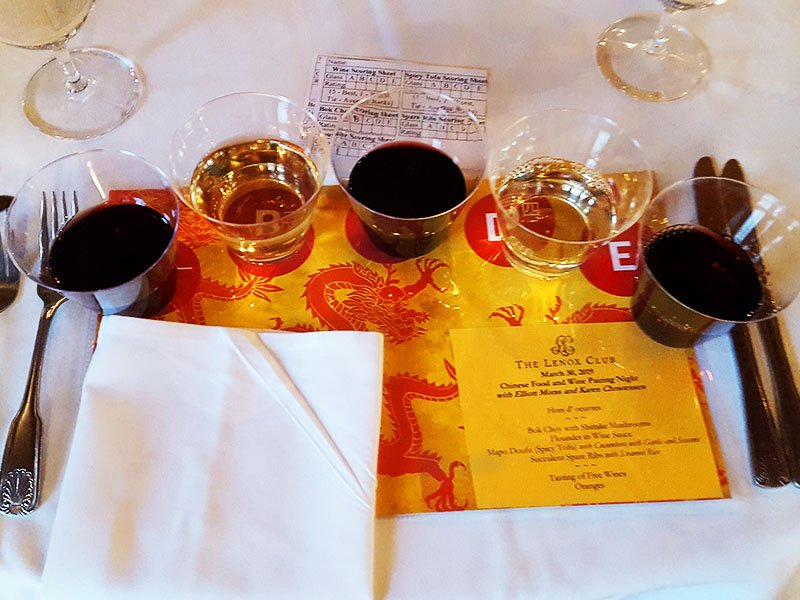
My first idea was to cook the meal myself. Elliott Morss, however, was able to arrange that our first Chinese food and wine tasting would be one of the winter International Nights at the Lenox Club in Lenox, Massachusetts. You’ll need to make (or order) four dishes with different flavor profiles and, to match this tasting, to have four different wines on hand.
The Wines
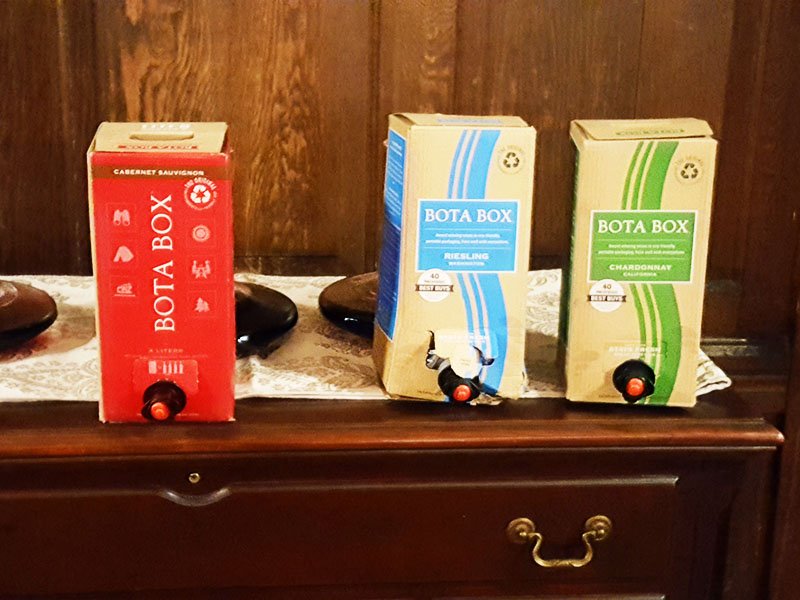
Elliott Morss has done extensive blind tastings with box wines thrown into the mix. The box wines got very high ratings, even compared to some expensive bottles, so we used Bota Boxes of four standard varietals at the Lenox Club event. You may use any wines you like, but make sure they are very different from one another.
Elliott chose:
- heavy red (Cabernet Sauvignon)
- light red (Pinot Noir)
- heavy white (Chardonnay)
- light white (Riesling)
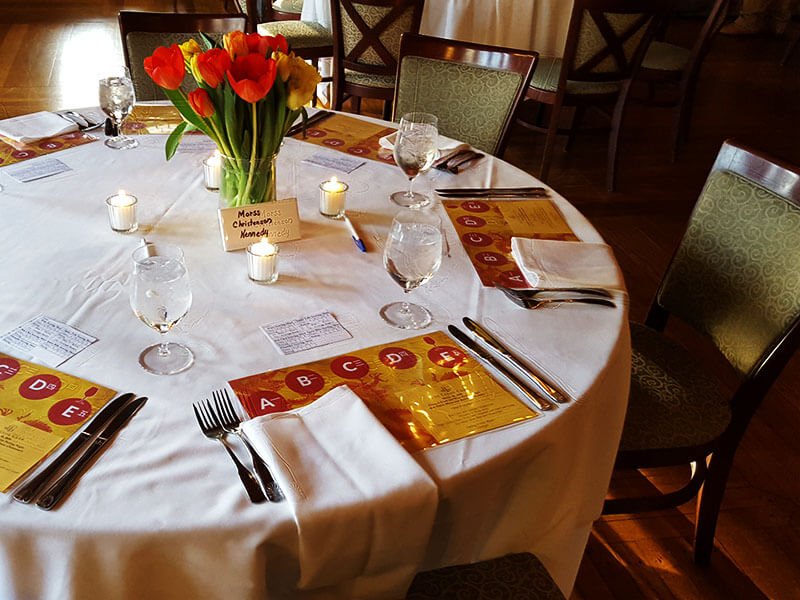
He also did something really sensible. He poured five glasses for each participant but only four wines. One wine, the same wine, is poured into two different glasses and treated as a fifth for purposes of tasting. Each person’s spread on his or her ratings of the same wine will indicate whether she or he can effectively distinguish between wines.
The Food
I had decided that the recipes had to be simple enough for a newbie cook, and, as much as possible, made with ingredients available in a large American supermarket. I also noted that “the failure state still has to be edible.” To prepare for the Lenox Club dinner, I looked for recipes that had the right flavor profiles and were suitable for preparation in an American country club kitchen. Here’s the list I made:
- Mild and sweet, without much spice, and without a strong meaty or savory component: black and white fish (I like Irene Kuo’s Fillet of Flounder in Wine-Rice Sauce) or maybe a shrimp dim sum
- Sweet: A Shanghainese dish? Or General Tso’s Chicken?
- Savory: a barbecued meat, or a clay pot dish with tofu and mushroom and aubergine
- Spicy (ma la): a dish with chilies and/or Sichuan pepper
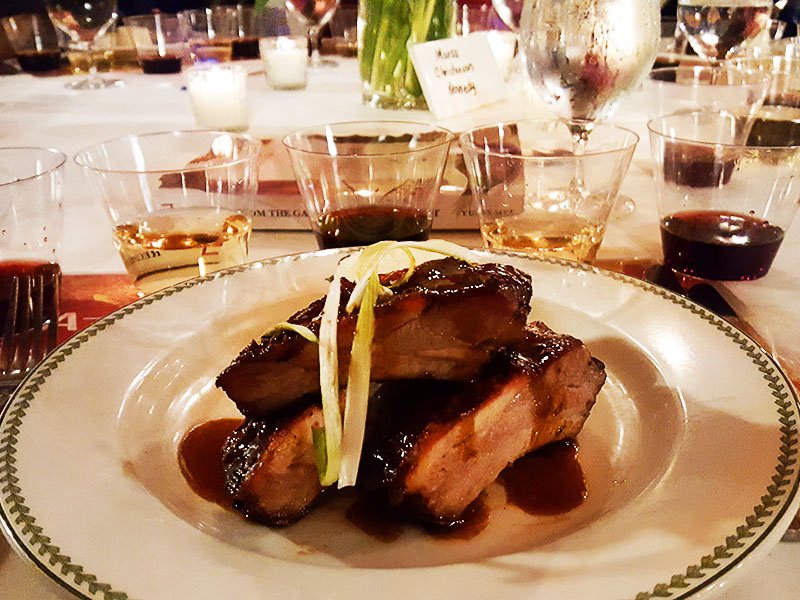
We went back and forth with the Club’s chef, Michael Roller. One issue was that the kitchen had no burners suitable for stir-frying. Michael and his staff were fantastic, and really got interested in the concept and recipes. Their bok choy with mushrooms was out of this world, and the ma po doufu really tasted of fresh Sichuan pepper. Here’s the final menu presented at the Lenox Club:
- Bok Choy with Shiitake Mushrooms
- Flounder in Wine Sauce
- Ma Po Dou Fu (spicy tofu, with a side of cucumbers, garlic, and sesame)
- Succulent Spare Ribs with Steamed Rice
I sent recipes from several favorite cookbooks (listed below), hoping they could be adapted for a commercial kitchen and large quantities (we were about forty people in the end). Here are some recipes I found online that are close to what the Lenox Club staff prepared:
- Bok Choy with Fresh Shiitake
- Velvet Fish With Mushrooms (Nassau Street Seafood) or Shandong fish napped with wine lees (Madame Huang’s Kitchen)
- Pock-marked old woman’s tofu recipe (Fuchsia Dunlop)
- Ken Hom’s Succulent Barbecued Spareribs
You’ll find a recipe for our cucumber, garlic, and sesame cold dish (in Chinese, the name means “smacked cucumbers”). This is the side dish served but not tasted with the wines.
The Results
Here’s Elliott’s summary:
- “For Bok Choy, Chardonnay enhanced the wine taste by the most, with Pinot Noir registering some improvement. Both Cabernet and Riesling did not taste as good.”
- “The common wisdom is that white wine goes best with a white fish. However, Chardonnay was the loser here with Riesling and Pinot Noir enhancing the wine.”
- “Riesling was the clear winner with Tofu with Pinot Noir not doing well.”
- “Spare ribs were interesting: one thinks a heavy red wine is best with a red meat. Not at our tasting. Our heavy red, the Cab, did not do well with the ribs. Riesling was again the winner.”
Do It Yourself!
Join the experiment by having each person fill in the form at Chinese Food & Wine Tasting: A Fresh Approach (this app works well on mobile devices so every participant can do rate the wines on their own phone). Or create a simple rating sheet like this one. Chinese meals are not served in courses, or not in courses as we know them. But for the purposes of a wine tasting, it makes sense to serve dishes one at a time, tasting each of the wines with each dish and rating them before moving on to the next.
I made reusable placemats by having our design copied at the local copy shop (on US legal-size paper) and then fitting each one into a plastic sleeve. This made it possible to slip a menu in for the event, too, yet have mats we could wipe off and use next time. We would love to have your suggestions for dishes (with recipes, if possible) and improvements to the methodology.
 Cookbooks used for the Lenox Club dinner: Dunlop, Fuchsia. (2013). Every grain of rice: Simple Chinese home cooking. New York: W. W. Norton. Kuo, Irene. (1977). The key to Chinese cooking. New York: Alfred A. Knopf. Hom, Ken. (1997). Easy Family Recipes from a Chinese-American Childhood. New York: Knopf.
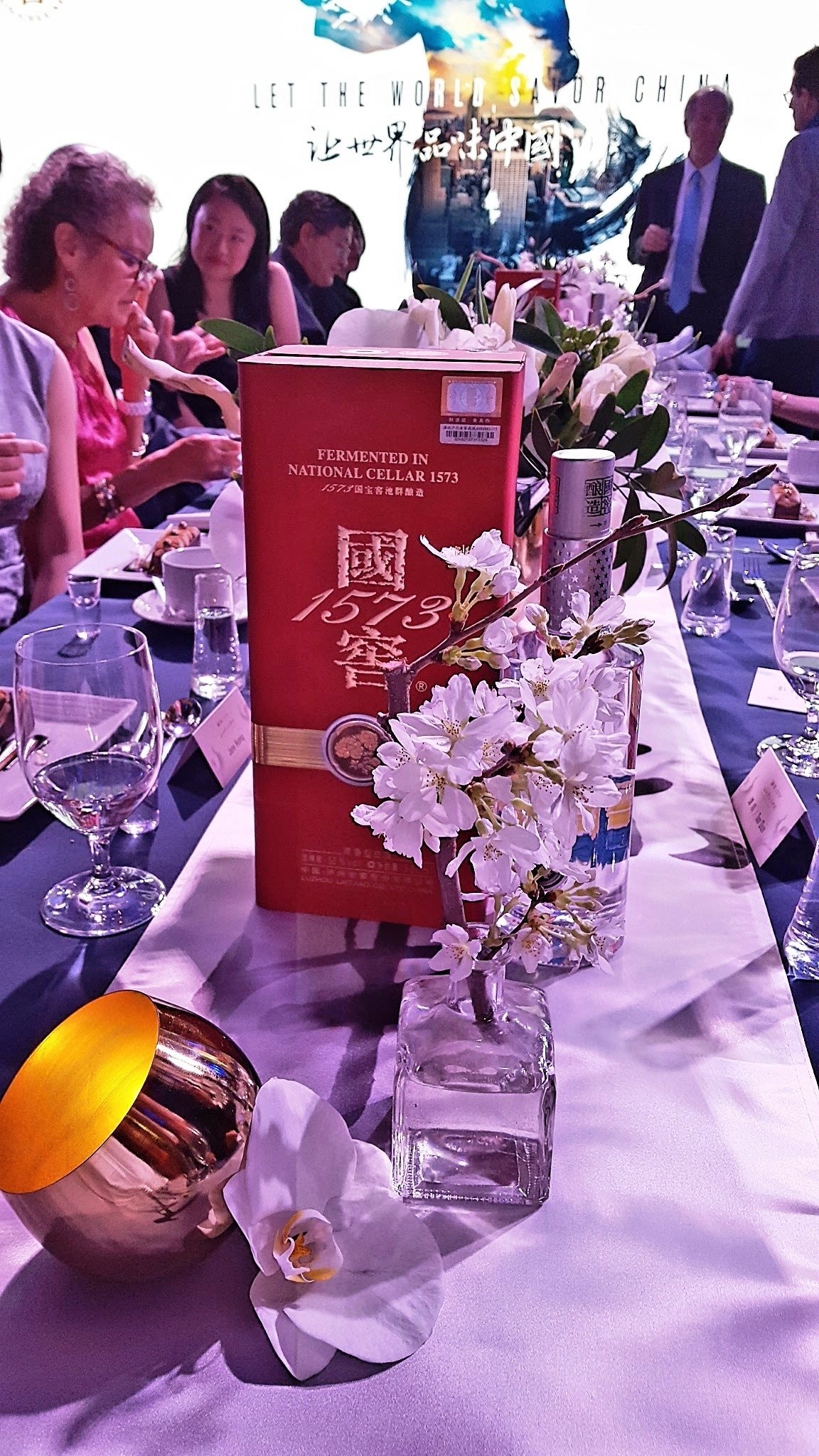
PS: I went to a launch dinner for a campaign to introduce baijiu in the United States. It was a grand affair, with a famous Chinese conductor and composer, Tan Dun, orchids everywhere, and rather good but entirely Western food. The baijiu, well, it’s still in my drinks cupboard. The tagline for the campaign was, in English, “Let the World Savor China.” I’m all for that, but let’s start with the wonderful food.